

 Re-mark
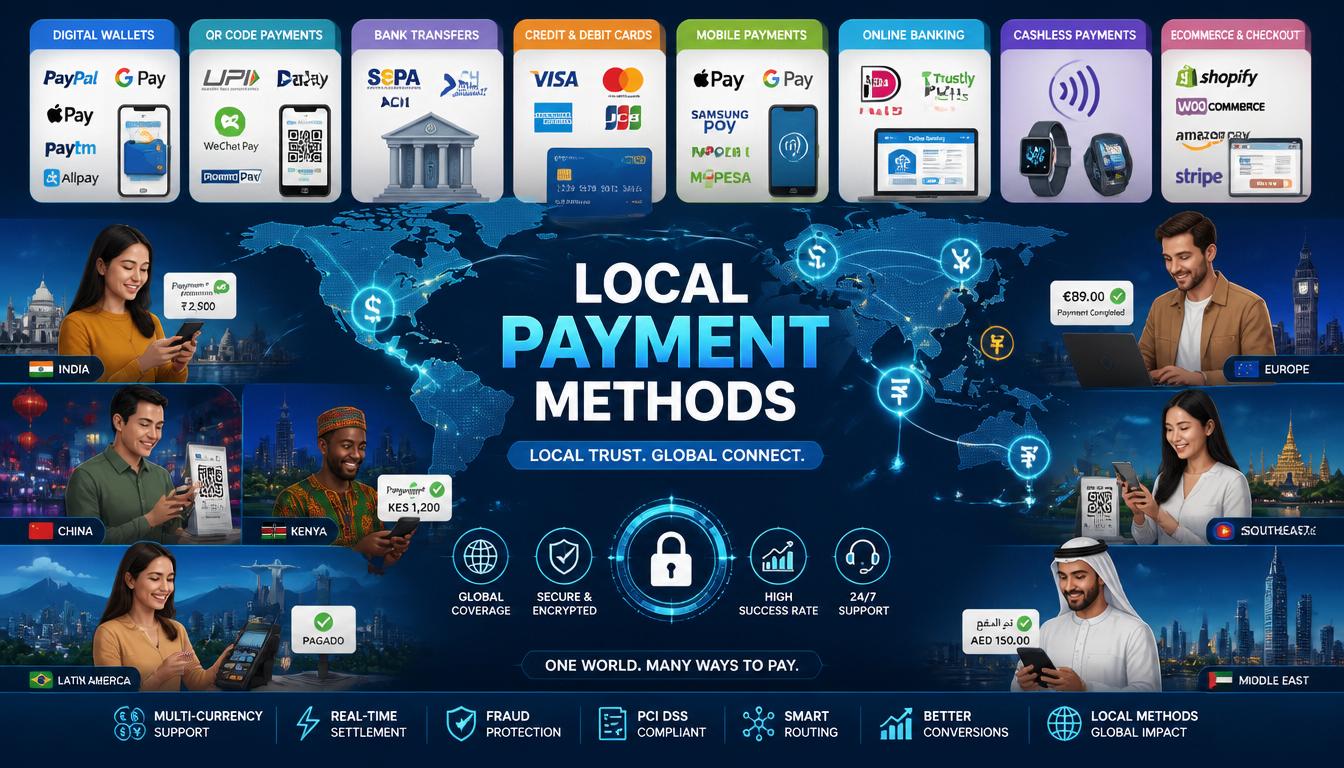
What Are Local Payment Methods? A local payment method is any payment option widely used in a specific country or region that isn't necessarily recognized or accepted globally. Unlike international credit cards that work almost anywhere, local payment methods are built around the financial habits, banking infrastructure, and consumer preferences of a particular market. They exist because not everyone has a Visa or Mastercard. In many countries, large portions of the population are unbanked or simply prefer alternatives they trust more than international card networks. Types of Local Payment Methods Bank Transfers: Direct bank-to-bank payments are the preferred method in many European and Asian markets. Customers log into their online banking and authorize a transfer at checkout, no card details shared, no third party involved. Digital Wallet: Apps that store payment information and allow one-tap purchases. Some operate globally, but many of the most-used wallets are deeply regionally dominant in one country and virtually unknown outside it. Cash-Based Vouchers: Customers complete a purchase online and receive a code or slip that they pay for in cash at a local convenience store or bank. Widely used in Latin America and Southeast Asia, where cash remains king. Buy Now Pay Later (BNPL): Installment-based payment options offered at checkout. Popularity varies significantly by country, deeply embedded in some Scandinavian and Australian markets, and still emerging elsewhere. Mobile Money: Payment systems are tied to a mobile phone number rather than a bank account. Transformative across sub-Saharan Africa, where mobile money accounts outnumber traditional bank accounts by a significant margin. Real-Time Payment Rails: Government or industry-built instant payment systems. These operate under local brand names and have become the default payment method for millions of consumers in markets where they've launched. Global Examples Worth Knowing Netherlands: iDEAL is the dominant online payment method in the Netherlands, used for the majority of all Dutch e-commerce transactions. It works as a direct bank transfer at checkout. Customers select their bank, authenticate through their own online banking app, and the payment is confirmed instantly without sharing any card details with the merchant. Brazil: Pix is the government-built instant payment system launched in 2020 and adopted at a scale few expected. Payments are made using a simple key, a CPF number, phone number, email, or QR code and settle in seconds, 24 hours a day, every day of the year. It has rapidly become the most used payment method in the country, overtaking both cash and cards for everyday transactions. India: UPI (Unified Payments Interface) is India's real-time mobile payment system that links directly to a bank account. Users send and receive money instantly using a virtual payment address or QR code, no card number, no cash, no delay. It processes billions of transactions monthly and has fundamentally transformed how everyday payments work nationwide. China: Alipay & WeChat Pay In China, two super-apps handle the overwhelming majority of digital payments. Alipay and WeChat Pay both operate through QR codes. Merchants display a code, customers scan it, and the payment is done in seconds. They are so deeply embedded in daily life that cash is largely unnecessary in most Chinese cities for anything from street food to luxury retail. Kenya: M-Pesa is a mobile money service that allows users to send, receive, and store money using nothing more than a basic mobile phone and a phone number, no bank account required. Launched in 2007, it became the financial backbone of Kenya and much of East Africa, giving millions of people access to reliable digital payments for the first time in regions where traditional banking infrastructure was limited or absent. Germany: SEPA Direct Debit Germany has long had a strong cultural preference for bank-based payments over credit cards. SEPA Direct Debit allows customers to authorize a merchant to debit their bank account at checkout. It's widely trusted across Germany and the broader European market, particularly for recurring payments, subscriptions, and higher-value purchases where buyers prefer not to use a card. Mexico: OXXO is a convenience store chain with thousands of locations across Mexico and also serves as a cash payment network for online purchases. Customers complete an order online, receive a payment voucher with a unique barcode, and take it to their nearest OXXO store to pay in cash. The payment is confirmed, and the order is processed. It's a practical and trusted bridge between digital commerce and a population that still heavily relies on cash for daily transactions.
You may like

The Crude Oil Price Chart is one of the most closely watched indicators in the global commodity market. Businesses,…

Best Wound Care Billing & Coding Services in the USA
Wound Care Biologics, Medical Billing companies
For NRIs and HNIs, the problem in 2026 is not just asset selection but capital mobility. A family earning money in the…